-

+86-13404286222
-

hmjxboss@gmail.com

INQUIRE NOW

+86-13404286222
hmjxboss@gmail.com
INQUIRE NOW
The compressor housing, as one of the core components of a compressor, has a design and manufacturing process that directly impacts the equipment's performance, efficiency, and service life. Among various manufacturing processes, casting of compressor housings stands out as a primary forming method due to its adaptability to complex geometric shapes and high structural integrity.
The compressor housing not only serves as a support structure for the internal components of the compressor but also performs functions such as pressure sealing, vibration isolation, and heat conduction. Therefore, the housing design must consider multiple factors from the outset, including structural strength, rigidity, pressure resistance, and corrosion resistance. Casting technology makes complex structures possible, allowing for thin-wall designs, reinforcement rib arrangements, and optimized internal channels, thus reducing material consumption while meeting mechanical requirements.
The geometric shape of the housing is usually complex, involving cavities, reinforcing ribs, and mounting flanges. Traditional machining methods struggle to efficiently complete the overall forming process. Casting, however, allows for one-piece molding, which not only improves production efficiency but also reduces stress concentration problems caused by welding and splicing, fundamentally guaranteeing the stability and reliability of compressor operation.
Common casting materials for compressor housings include cast iron, aluminum alloys, and magnesium alloys, each with its specific advantages. Cast iron offers good wear resistance and damping properties, helping to reduce operating noise; aluminum alloys offer lightweight advantages and excellent thermal conductivity, suitable for compressor applications requiring heat dissipation; magnesium alloys are even lighter, but require more stringent process control.
Material selection not only affects mechanical properties but also determines the requirements for temperature control, fluidity, and solidification characteristics during the casting process. Materials with poor fluidity are prone to porosity, inclusions, and shrinkage cavities, while rapid cooling can lead to cracks or internal stress accumulation. Therefore, understanding material characteristics and matching them with appropriate casting processes is a core aspect of ensuring housing quality.
The casting process for compressor housings mainly includes several key steps: mold design, melting, pouring, solidification, and post-processing. Mold design needs to consider the runner system, vents, and cooling system layout to ensure that the molten metal uniformly fills the mold cavity and that gases are smoothly expelled. The melting process requires strict control of temperature and composition to ensure the uniformity and cleanliness of the molten metal, thereby reducing the generation of defects.
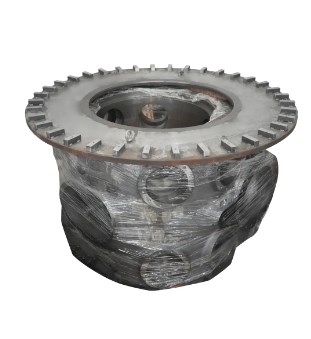
The pouring stage has a significant impact on the cast product. Too fast a pouring speed can easily cause turbulence and porosity, while too slow a speed may lead to segregation or insufficient local cooling. The solidification stage requires controlling the cooling rate and direction to form a reasonable grain structure, improving the mechanical properties and durability of the casing. Post-processing includes deburring, heat treatment, and surface treatment, which not only improves the appearance but also eliminates internal stresses and enhances the overall strength and toughness of the casing.
In the casting process of compressor casings, defect control is a key focus of process optimization. Common defects include pores, shrinkage cavities, cracks, and inclusions. These defects directly affect the sealing performance and pressure resistance of the casing. Through scientific process parameter design, optimization of the pouring system, and strict melting management, the defect rate can be effectively reduced.
Modern casting processes also incorporate numerical simulation and testing technologies. Computer simulation can predict molten metal flow, solidification processes, and stress distribution, allowing for early optimization of design and process plans. Non-destructive testing techniques are used for finished product inspection, such as X-ray inspection and ultrasonic testing, which can accurately detect internal defects and ensure the reliability of each casing.
High-quality compressor casing casting not only guarantees mechanical strength and sealing performance but also improves vibration characteristics and heat dissipation performance. A uniform and dense structure reduces stress concentration points, improving pressure resistance and fatigue life; a reasonable thickness distribution and reinforcing rib layout optimize vibration frequency and reduce operating noise; excellent thermal conductivity helps to quickly conduct heat, improving the operating efficiency and stability of the compressor.
Casting also provides a certain degree of design freedom, allowing engineers to optimize the internal channels and cavity structure for different operating conditions, thereby improving overall performance without increasing weight. Overall, casting technology provides an irreplaceable manufacturing solution for high-performance compressor casings.
A: The main factors considered are mechanical properties, corrosion resistance, thermal conductivity, and weight, while also matching the flow and solidification characteristics of the casting process.
A: Defects can be effectively reduced by optimizing the gating system, controlling melting temperature, designing appropriate cooling rates, and utilizing numerical simulation and non-destructive testing techniques.
A: High-quality cast casings can improve sealing, pressure resistance, and vibration characteristics, while also improving heat dissipation, thereby increasing the overall efficiency and lifespan of the compressor.
A: Post-processing, including deburring, heat treatment, and surface treatment, eliminates stress, improves toughness, and enhances surface quality, ensuring the long-term stable operation of the casing.
 No. 16 Dayuanli Road, Yunting Street, Jiangyin City, Jiangsu Province, China
 +86-13404286222 / +86-13404286222
 +86-510-86668678
 hmjxboss@gmail.com
Copyright © Jiangyin Huanming Machinery Co., Ltd. All Rights Reserved.Custom Large Components Mechanical Processing Manufacturers

 English
 中文简体
中文简体 русский
 日本語
日本語 Español