-

+86-13404286222
-

hmjxboss@gmail.com

INQUIRE NOW

+86-13404286222
hmjxboss@gmail.com
INQUIRE NOW
Sourcing HPGR roller tire components sits much closer to buying a rotating pressure vessel than to buying a spare part. A high pressure grinding roll sits at the head of a cement or mineral circuit, and the tire is the only component that meets the ore bed thousands of times an hour. A tire that arrives 0.2 mm out of tolerance, or with a hardness map that stops at the machined surface, does not fail in the supplier's workshop. It fails mid-campaign, on a night shift, with the feed still running.
Procurement teams often treat the tire the way they treat a pump housing: issue a drawing, compare three quotations, confirm the delivery date. That routine holds until the first set of tires is consumed in a fraction of the projected life. The variables that decide the outcome are locked in long before the first cut is taken, and they include steel cleanliness, forging reduction, heat treatment depth, stud retention, inspection coverage and the supplier's willingness to document all of it.
An HPGR roller tire set is the complete rotating wear assembly of a high pressure grinding roll: the forged or cast tire body, the grinding surface formed by studs or welded hardfacing, the shaft, the torque-transfer locking arrangement, and the bearing and housing group that positions the roll under load.
The roller tire is the replaceable outer ring mounted on the roller shaft. It carries the studs or overlay that form the real grinding surface, and it is the only part of the machine designed to be consumed and exchanged on a planned maintenance cycle.
Roller diameters and specific pressing forces have climbed for three decades, and the technological evolution of HPGR roller tires has followed the same curve: heavier section, deeper hardness, denser stud pattern and tighter runout control at every stage.
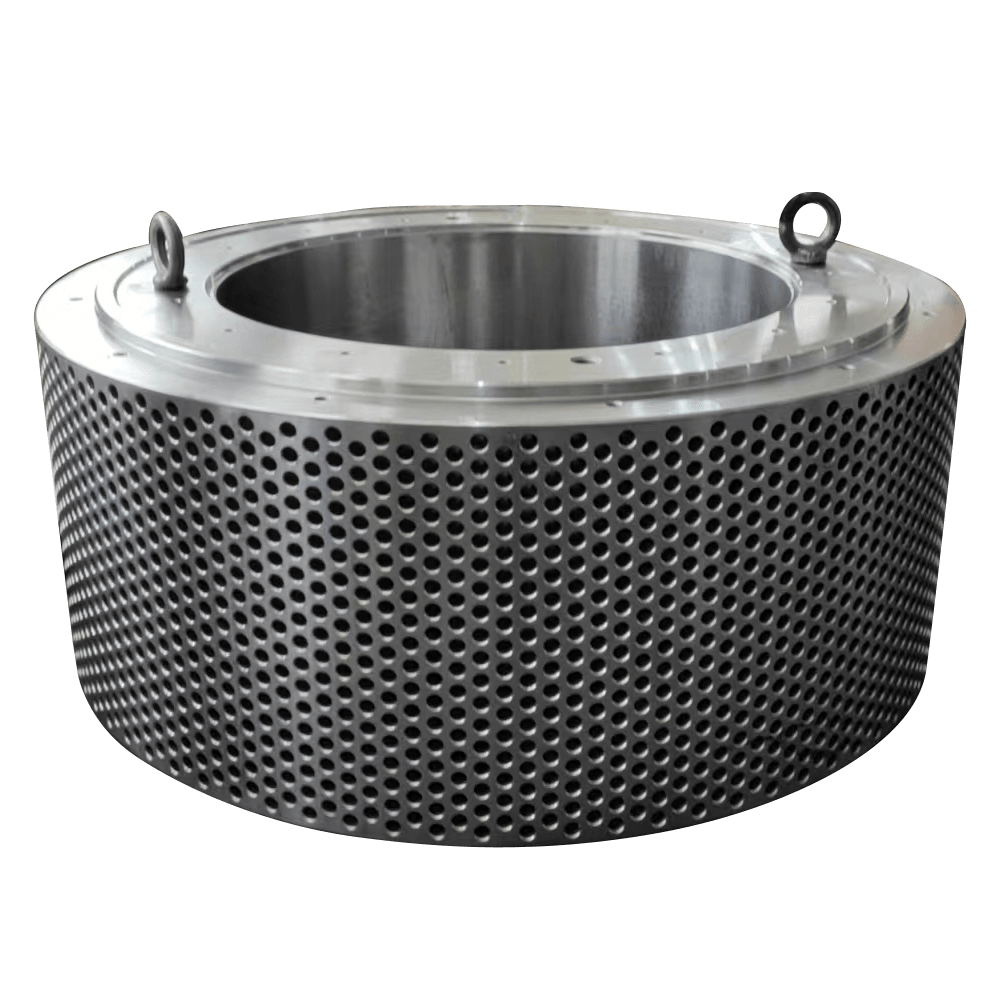 HPGR Tire Parts Rollers ManufacturersThe roller is an important equipment component of the roller mill and is mainly used in the mining industry, metallurgical industry, chemical industry, cement machiner...View Product →
Most premature HPGR tire failures are decided by material grade, forging reduction and heat treatment, not by the final machining tolerance. A tire that leaves the press with insufficient reduction carries centreline segregation that no later heat treatment removes, and that segregation becomes a crack path once the studs begin transmitting load.
The second recurring specification error is hardness written as a single number. A tire at 340 HB on the machined face and 260 HB at 40 mm depth behaves completely differently from one that holds 320 HB across the same depth, even though both pass the incoming hardness check.
This is exactly why the material route belongs inside the sourcing decision. Suppliers such as Jiangyin Huanming Machinery Co., Ltd. keep casting, forging, welding and heavy machining under one roof, which shortens the loop between a hardness deviation found during heat treatment and the corrective action taken on the forging schedule.
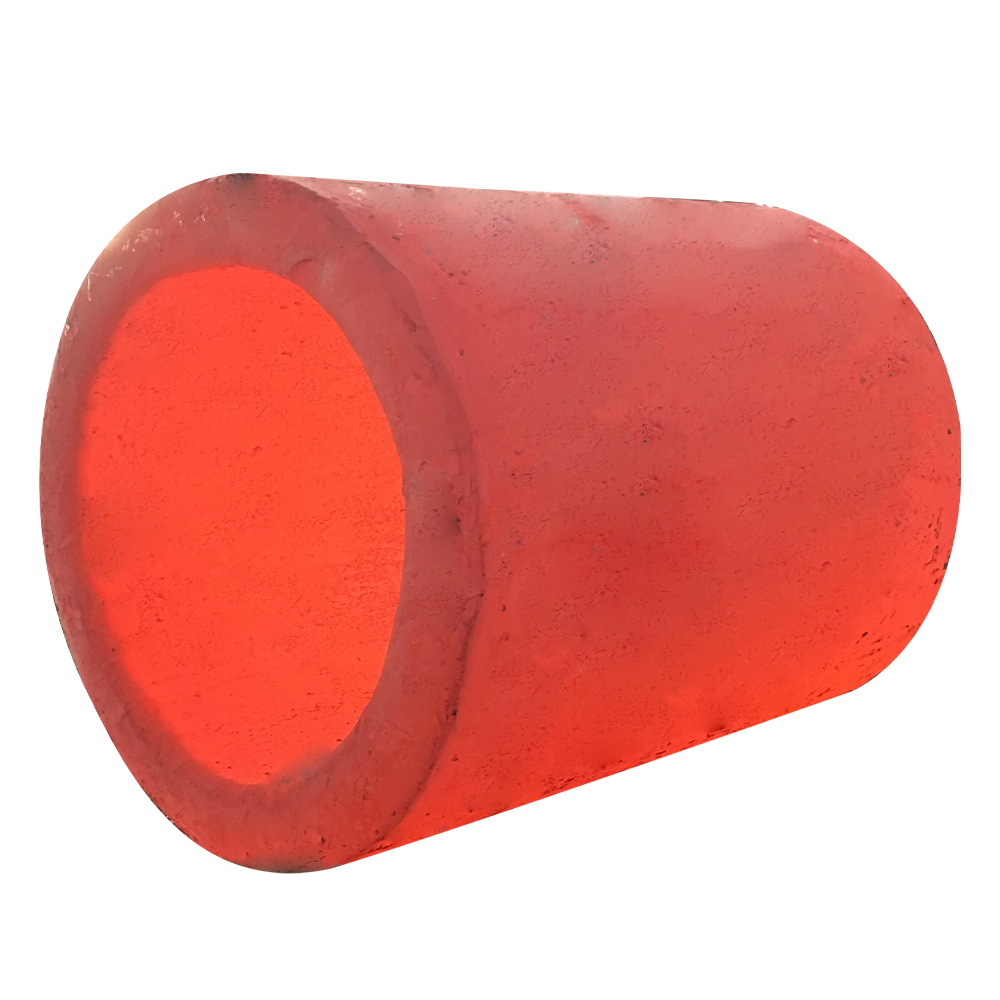 Forging Casting Parts Processing ManufacturersForging and casting are both important metal processing methods in the industry, and they have wide-ranging applications. They have significant differences in terms of...View Product →
Studded tires dominate hard rock and cement raw grinding because carbide studs renew the grinding texture as the matrix wears away; welded overlay tires make sense on softer, finer feeds and in plants that already hold qualified welding capability on site.
The purchasing question is not which surface is better in general, but which one matches your feed size, your specific pressing force and the maintenance capability you actually have on site.
A complete delivery file for an HPGR roller tire contains five document groups: material certification, heat treatment records, volumetric and surface NDT reports, dimensional and runout records, and stud or overlay verification data.
Purchase orders that name these documents up front rarely end in disputes, because the acceptance criteria are agreed before the steel is melted.
Runout and hardness consistency matter more than raw diameter accuracy, because a tire works inside a loaded gap measured in millimetres and every deviation is multiplied by the separating force.
| Parameter | Commonly specified value | What happens if it is missed |
| Tire outside diameter | 1.0 to 2.4 m, matched to the machine frame | The roll gap cannot be set to design without shimming |
| Radial runout after final machining | Held below roughly 0.10 mm | Cyclic loading, uneven bed and vibration at high pressure |
| Body hardness | 300 to 380 HB on the machined face | Surface fatigue and early stud pull-out |
| Hardness depth | A defined curve to 30 or 50 mm | A soft core deforms plastically under the separating force |
| Stud pattern pitch | Within about 1 mm of drawing | Wear bands and localised gouging across the face |
| Bore and shaft fit | Interference defined by drawing, no hand fitting | Creep on the shaft, fretting and cracking at the keyway |
Qualification should verify process ownership rather than catalogue claims, because a supplier that controls melting, forging, heat treatment, hardfacing and final inspection under one quality system can trace a defect to its source instead of arguing about it.
Large-tire sourcing works best when the supplier is engaged while the specification is still open. Where the tire, shaft and housings are sourced together, it is worth contacting the manufacturing team early enough to align the drawing, the material route and the inspection plan in a single pass.
A well specified studded tire in cement raw grinding commonly runs 8,000 to 12,000 hours before the studs need attention, and the tire body is usually good for one or two resurfacing cycles. Tires that lose hardness depth or runout control often reach the same condition in half that time.
Both routes are in production. Forged tires dominate large, high-pressure installations because forging closes internal porosity and delivers a more uniform hardness response, while cast tires remain common on smaller rolls and in lower-pressure duty.
Specifying hardness as a single surface value and treating the inspection file as optional. Buyers who fix the hardness curve, the stud retention test and the NDT acceptance level at the quotation stage remove most of the risk that later appears as premature wear.
Yes, and it usually shortens the assembly cycle. A supplier with casting, forging, welding and large machining capability can match the bore fit to the actual shaft rather than to a nominal drawing, which is where most concentricity complaints originate.
 No. 16 Dayuanli Road, Yunting Street, Jiangyin City, Jiangsu Province, China
 +86-13404286222 / +86-13404286222
 +86-510-86668678
 hmjxboss@gmail.com
Copyright © Jiangyin Huanming Machinery Co., Ltd. All Rights Reserved.Custom Large Components Mechanical Processing Manufacturers

 English
 中文简体
 русский
 日本語
 Español
