-

+86-13404286222
-

hmjxboss@gmail.com

INQUIRE NOW

+86-13404286222
hmjxboss@gmail.com
INQUIRE NOW
A pump body casting is quoted by weight, but it is bought and rejected on process control. The specification attached to the RFQ decides which foundries bid, how they price the work, and how much rework reaches your assembly line six months later.
Pump body castings are the pressure-containing and structural housings of a pump, formed by pouring molten metal into a mould and then machined to final dimensions. A single RFQ often bundles several distinct parts under that name.
Most industrial pump bodies shipped today fall between 50 kg and 2,000 kg. Below 50 kg, investment casting becomes competitive; above one tonne, sand casting is effectively the only economic route.
Match the grade to the fluid and the operating window first, and to the drawing default second. Gray and ductile iron still cover the large majority of industrial pump bodies; stainless and duplex grades appear wherever corrosion, chlorides or hygiene rule iron out.
| Grade | Typical service | Minimum tensile strength | Main watch-out |
| Gray iron, ASTM A48 Class 30 | Water, mild chemicals, up to 230 degrees Celsius | 207 MPa | No elongation; brittle under thermal shock |
| Ductile iron, 65-45-12 | High-pressure water, slurries, shock loading | 448 MPa, 12 percent elongation | Shrinkage porosity in heavy sections |
| CF8M, cast 316 stainless | Seawater, acids, food and pharmaceutical duty | 485 MPa | Higher cost; gating and feeding sensitive |
| Duplex 2205 | Chloride-rich, sour and offshore service | 620 MPa, 450 MPa yield | Cooling control; full NDT is normal |
| Nickel alloys such as Inconel 718 | High temperature and aggressive chemistry | Varies by heat treatment | Limited foundries; long lead time |
Above roughly 300 degrees Celsius, or where chloride levels exceed about 200 ppm, cast iron and 316 stainless both stop being safe defaults. That is where a supplier with a real special materials capability matters, because duplex 2205, Inconel 718, Inconel 625 and Haynes 188 held to drawing are the difference between a quote and a shipment.
For pump bodies above roughly 50 kg, green sand casting is the default route; the alternatives win only when wall thickness, surface finish or lot size justify the extra cost.
| Route | Minimum practical wall | Typical linear tolerance | Best fit |
| Green sand casting | 6 to 8 mm | plus or minus 1.0 to 1.5 mm per 100 mm | Casings from 50 kg to 5,000 kg |
| Shell moulding | 3 to 5 mm | plus or minus 0.5 mm per 100 mm | Mid-size bodies needing better finish |
| Investment casting | 2 to 3 mm | plus or minus 0.15 mm per 100 mm | Bodies under about 50 kg |
| Lost foam | 5 to 6 mm | plus or minus 0.8 mm per 100 mm | Complex internal passages |
Lead time is where sourcing plans break. Pattern making takes four to six weeks, a first article another two to three weeks after that, and production castings typically run eight to twelve weeks from purchase order. Add two to four weeks if the supplier also machines the body.
Weight drives only part of the quoted price. Machining allowance, NDT coverage and the documentation package usually explain why two quotes for the same drawing differ by 30 percent.
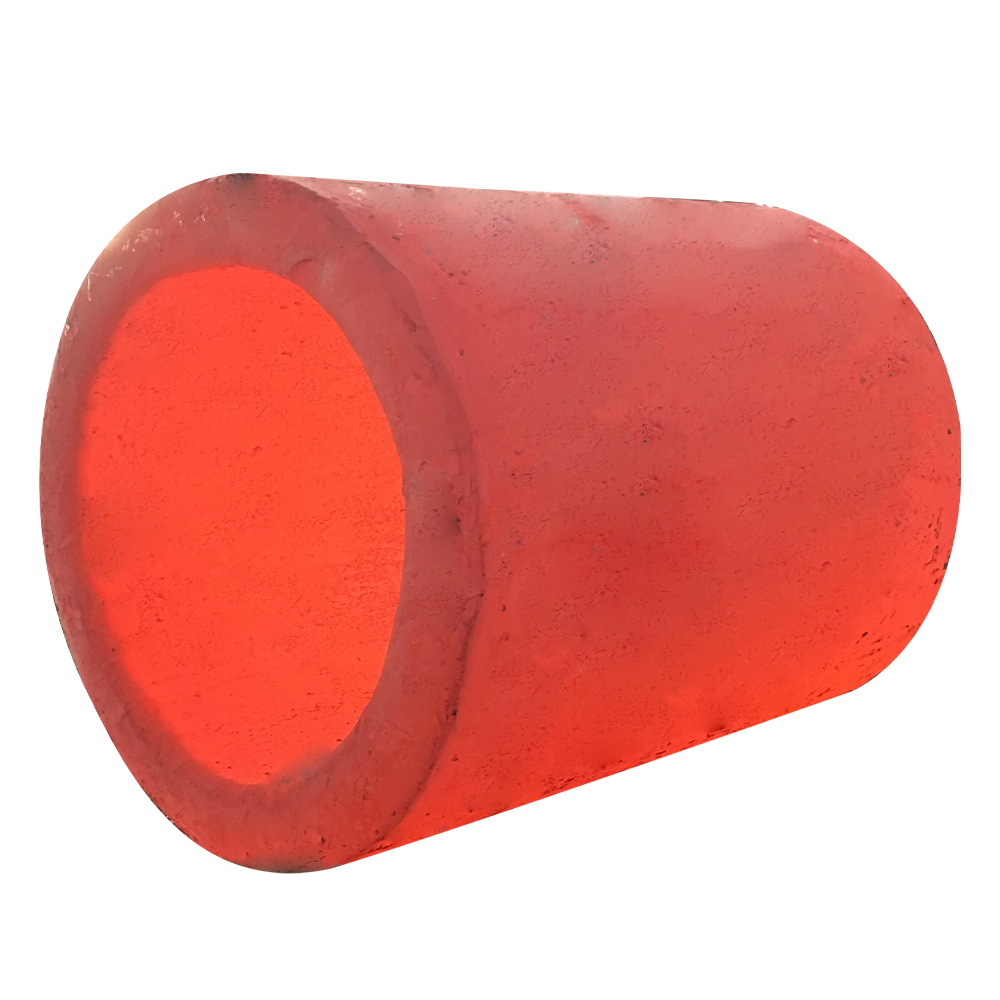 Forging and Casting Parts Processing for Industrial ComponentsCompare forging and casting methods for metal parts, with attention to machining allowance, NDT coverage, and documentation that shape foundry quotes.View Product →
Foundries price exactly what you specify, so a vague drawing attracts either an inflated quote or an under-scoped one. Five items decide the number.
Most rejections still trace back to internal porosity and dimensional drift. The chart below shows how heavy-section casing rejections typically distribute at final inspection.
Buying the casting and the machining from one supplier removes a handling cycle and, more importantly, removes the argument about who caused a dimension that will not clean up.
When a raw casting arrives at a machining shop with no inspection data, the first operation often becomes a re-datum exercise. An integrated supplier measures the casting against the same datum used for the pattern, adjusts the allowance and holds the pressure boundary wall inside tolerance. Jiangyin Huanming Machinery Co., Ltd. runs horizontal and gantry machining centres, CNC boring mills and high-speed vertical lathes with quoted accuracy of 8 micrometres, which is the range where a bore-to-flange concentricity callout of 0.05 mm stays achievable in production.
In-house magnetic particle and ultrasonic testing, hardness checks and surface roughness measurement on the same site as the machine shop is what keeps a first article from becoming a third attempt.
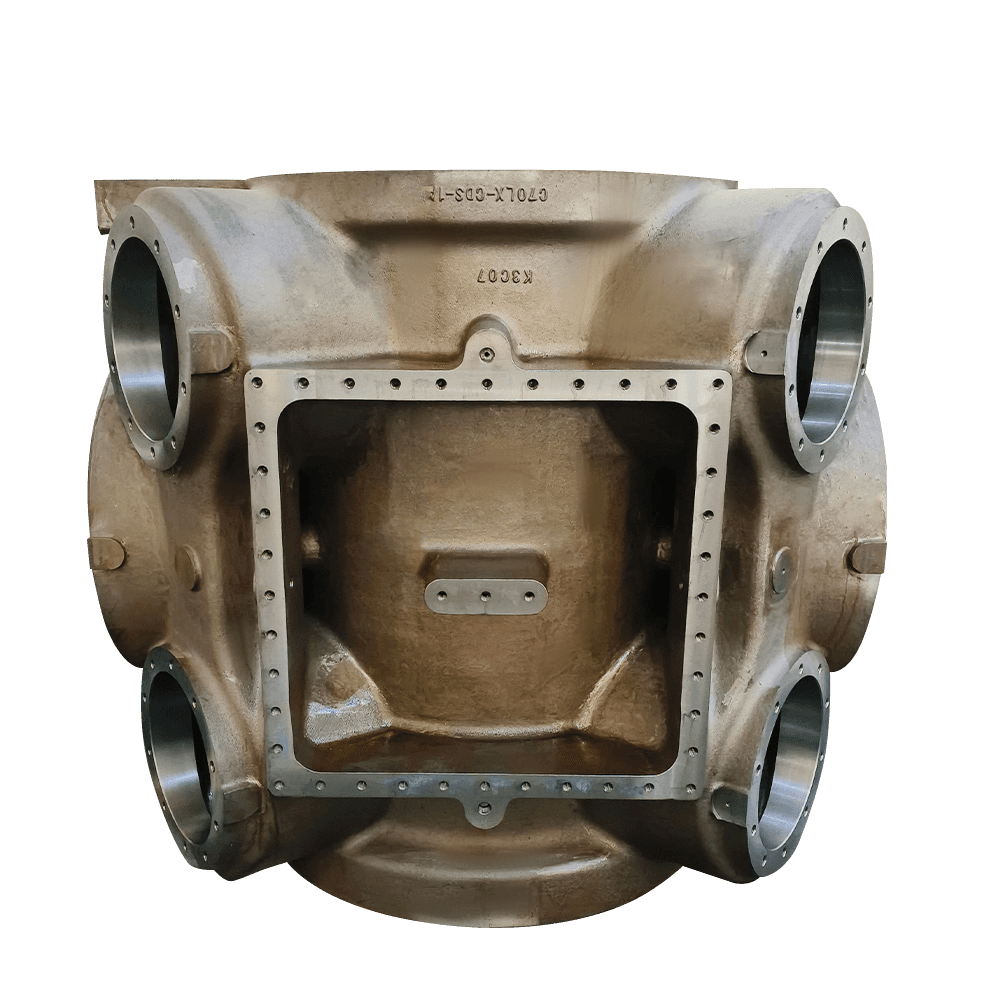 Cast Cylinder Blocks for Engines and Hydraulic SystemsReview cast cylinder block production where precision machining and in-house magnetic particle, ultrasonic, hardness, and surface checks help verify quality before full production.View Product →
Audit the process, not the brochure. Two foundries can both hold ISO 9001 while only one of them can state its heavy-section scrap rate for last quarter.
Whatever model you choose, request these five items before releasing a first order.
Internal porosity is the leading cause, accounting for roughly a third of final inspection rejections on heavy-section casings. It comes from gating and feeding design rather than operator error, so ask for the riser layout, pouring temperature range and the section modulus used for the thickest wall before you approve a pattern.
Allow four to six weeks for pattern making, two to three weeks for the first article, and eight to twelve weeks for production castings after approval. If the supplier also machines the body, add two to four weeks. Compressed schedules are possible but rarely worth the NDT risk on pressure-containing parts.
For pressure-containing bodies, yes. One supplier controls the datum from pattern to finished bore, which prevents the clean-up argument that appears when a casting arrives with no inspection record. The trade-off is less price competition, so keep at least one alternative source audited and approved.
Duplex 2205 for continuous seawater service, and super duplex where chlorides and temperature both run high. CF8M is acceptable only for intermittent or low-chloride duty. Cast iron is not suitable, and duplex bodies should ship with full ultrasonic testing on the pressure boundary plus a ferrite check on any repair.
 No. 16 Dayuanli Road, Yunting Street, Jiangyin City, Jiangsu Province, China
 +86-13404286222 / +86-13404286222
 +86-510-86668678
 hmjxboss@gmail.com
Copyright © Jiangyin Huanming Machinery Co., Ltd. All Rights Reserved.Custom Large Components Mechanical Processing Manufacturers

 English
 中文简体
 русский
 日本語
 Español
