-

+86-13404286222
-

hmjxboss@gmail.com

INQUIRE NOW

+86-13404286222
hmjxboss@gmail.com
INQUIRE NOW
A compressor housing that fails its hydrostatic test at 1.5 times working pressure has already been machined, inspected, and booked into an assembly slot. That is why equipment manufacturers treat compressor housing castings as a risk decision first and a purchase order second.
A compressor housing casting is the pressure-containing shell of a compressor: one rigid body that carries the rotor bore, inlet and discharge passages, bearing seats, and mounting feet. Rotor clearance, seal life, and the vibration signature of the finished machine are all set by how well that casting holds its geometry and its density after cooling. The process route behind a pressure casing is examined in more detail in this analysis of why compressor housing casting quality decides compressor performance.
Four specifications decide whether a housing survives your assembly line: pressure tightness at test, bore-to-bore alignment, wall thickness uniformity, and mounting interface flatness. Alloy price, foundry location, and payment terms are negotiable. These four are not.
Gray cast iron remains the default for most compressor housing castings because its flake graphite structure damps vibration better than any alternative at the same cost. The exception is pressure class: above roughly 40 bar, or where thermal cycling is severe, ductile iron or cast steel takes over.
Grade selection usually follows three inputs: maximum working pressure, the pulsation signature of the compressor type, and the thermal cycling the casing will see in service.
| Material and grade | Tensile strength | Typical housing mass | Where it is the right choice |
| Gray cast iron GG25 / GG30 | 250 to 300 MPa | 200 to 3,000 kg | Oil-flooded screw and air-cooled units where damping and cost matter |
| Ductile iron GGG40 / GGG50 | 400 to 500 MPa | 200 to 5,000 kg | Reciprocating machines with strong gas pulsation |
| Cast steel WCB / GS-52 | 480 to 650 MPa | 500 to 8,000 kg | Process gas and high-pressure casings with weld-on nozzles |
| Nickel alloy Inconel 718 / 625 | 900 MPa and above | 100 to 2,000 kg | High-temperature or corrosive gas service |
Above the standard grades, material selection stops being a catalogue decision. Casings for aggressive service move into nickel alloys such as Inconel 718 and similar heat-resistant grades, where heat chemistry, forming route, and machining parameters have to be validated together.
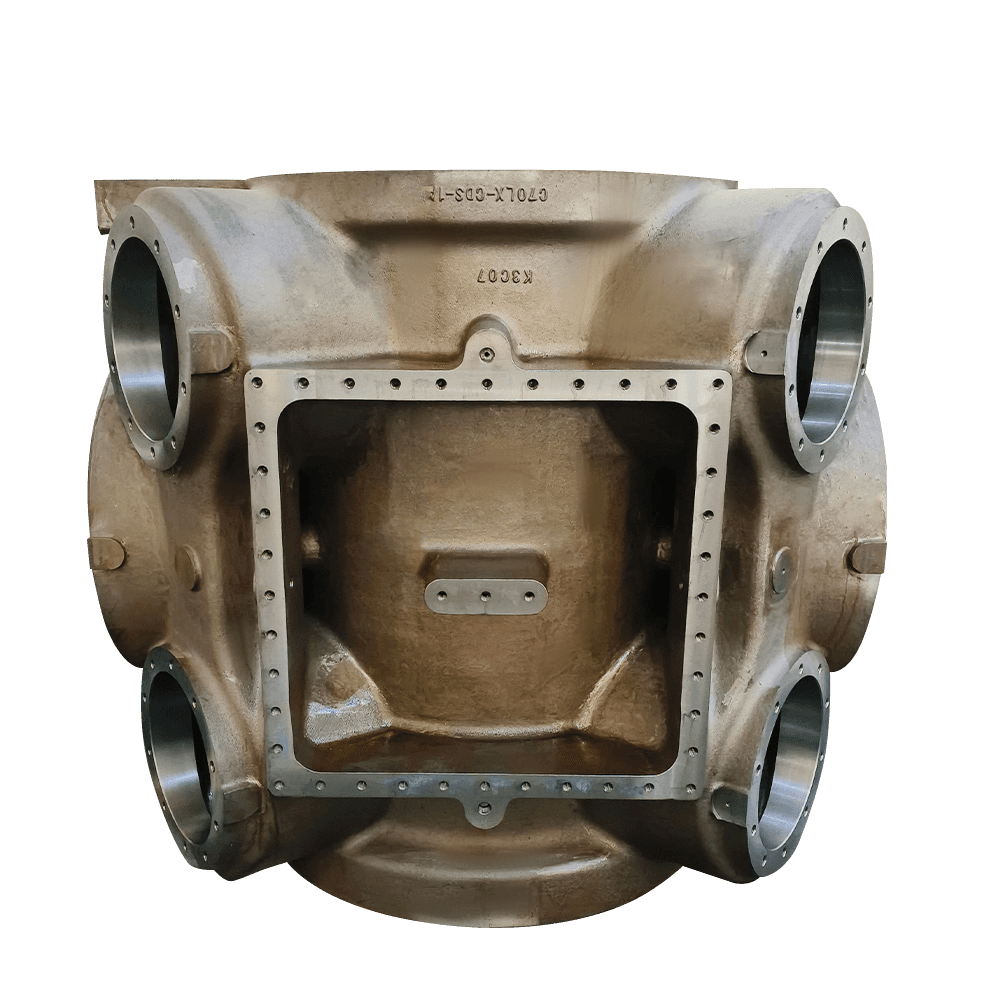 Cylinder Block Casting ManufacturersCast cylinder block is an important component used in the field of mechanical engineering, usually cast from high-strength metal alloys such as cast iron or aluminum a...View Product →
Pressure tightness is a process outcome, not a material property. Two foundries can pour identical GG25 chemistry and deliver completely different leak rates, because the difference sits in gating, riser placement, cooling rate control, and how the heavy sections are fed.
Across a 200-tonne program of large housings, rejects concentrate in a small number of causes.
Sand inclusion and shrinkage porosity together account for roughly six of every ten rejects. Both are process variables a foundry controls through gating design, mould quality, and chill placement, not through more inspection at the end of the line.
Buyers should ask for volumetric NDT across the pressure boundary, magnetic particle inspection on machined surfaces, a hardness map of the heaviest section, and a hydrostatic or pneumatic test record tied to the casting serial number.
Every additional setup on a large housing adds stack-up error, so the most reliable way to protect bore alignment is to machine the casting in as few setups as the geometry allows.
That constraint pushes buyers toward suppliers who cast and machine under one roof. A housing cast in one facility and bored in another arrives with two independent tolerance chains, and neither party owns the final result.
Benchmarks worth verifying before award are casting output, the accuracy the machine shop can hold on a housing of your mass, and how many comparable casings the supplier ships each year.
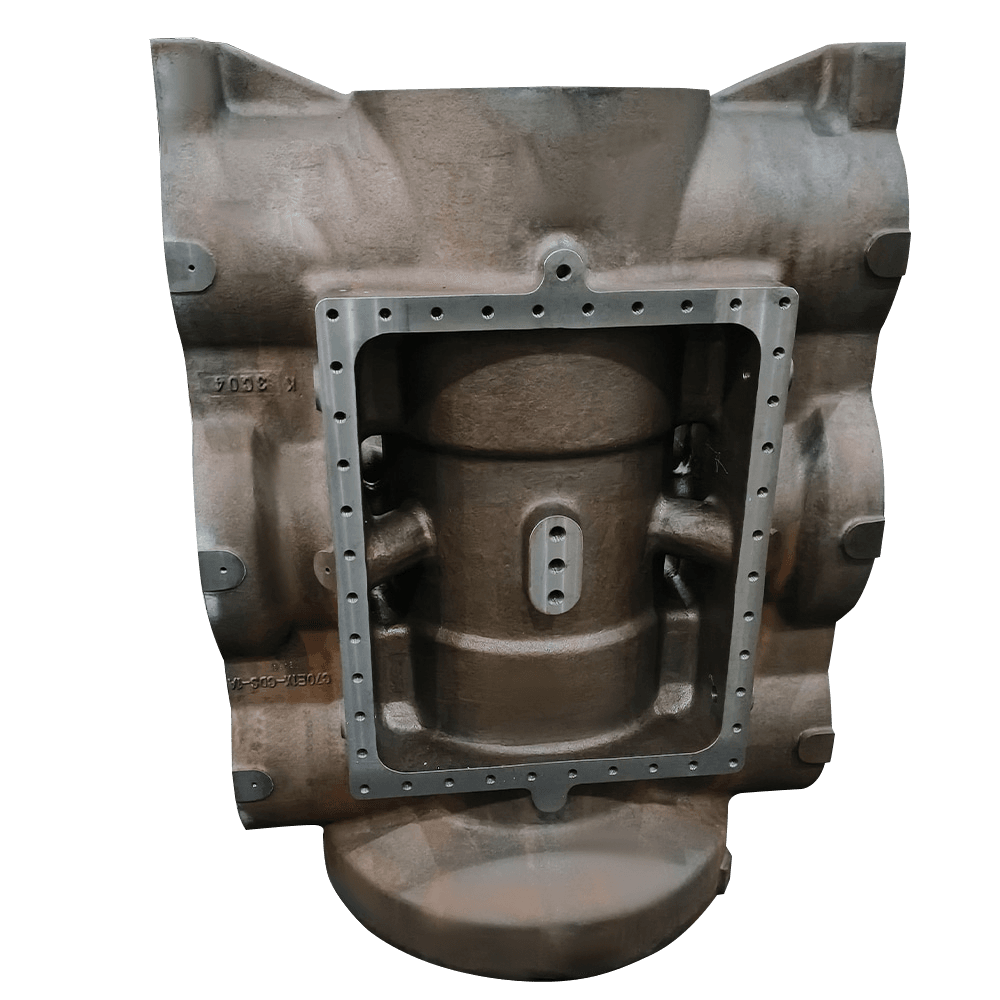 Casting of Compressor Housing ManufacturersLarge compressors usually adopt heavy-duty structural designs, which can withstand high-intensity loads and therefore have strong continuous operation capabilities. Ad...View Product →
Qualify a supplier on six items before the first pattern is cut: material traceability, volumetric NDT capability, dimensional reporting scope, in-house machining, test documentation, and a written repair policy.
Lead time and cost follow from the same list. Pattern making plus first article approval typically runs 6 to 10 weeks, and production batches run 4 to 8 weeks depending on mass and machining scope. Wall thickness increases, wider NDT coverage, and post-cast repair are the three factors that move price most, and each one is a buyer decision rather than a surprise from the foundry.
Price per kilogram is the least useful number in a housing casting quotation. Verify proof pressure, bore alignment, NDT scope, and machining ownership first, then negotiate the rate.
Wall thickness is set by pressure class and by the feeding distance of the alloy, not by one universal rule. Gray iron housings between 200 and 3,000 kg commonly run 12 to 25 mm shells with thicker flanges and ribs, and any section above 60 mm needs riser and chill design validated before production starts.
Hydrostatic or pneumatic testing at 1.5 times maximum working pressure, supported by volumetric NDT on the zones that contain gas. Test records should be traceable to the heat number and to the individual casting serial.
Isolated defects outside the pressure boundary can be repaired by controlled welding with preheat and post-weld inspection. Defects inside a rotor bore or a gas passage are normally grounds for rejection, so the repair policy belongs in the purchase order before the first casting is poured.
Plan 6 to 10 weeks for pattern making, first article, and approval, then 4 to 8 weeks for each production batch depending on casting mass and machining scope. Special alloy grades add several weeks because heat chemistry verification slows the first article.
 No. 16 Dayuanli Road, Yunting Street, Jiangyin City, Jiangsu Province, China
 +86-13404286222 / +86-13404286222
 +86-510-86668678
 hmjxboss@gmail.com
Copyright © Jiangyin Huanming Machinery Co., Ltd. All Rights Reserved.Custom Large Components Mechanical Processing Manufacturers

 English
 中文简体
 русский
 日本語
 Español
